V08 — Steady and transient heat conduction
Tier A - Analytic
Tier A (analytic) - priority P0
Reference frozen on 2026-08-13. Nabla 0.1.0,
solver licence mode enforcing,
run in 48.0 s.
1. Problem
Six heat-conduction problems, each solved twice - once with linear (P1) and once with quadratic (P2) elements. Twelve models, no coils, no magnets, no current anywhere: this is the chapter where the thermal module is the only thing under test.
| Sub-model | Formulation | What it is | What only it can fail on |
|---|---|---|---|
slab_p1 / slab_p2 |
planar | slab, uniform generation, both faces held (BC 20) | the Cartesian kernel, the volumetric source, Dirichlet |
conv_p1 / conv_p2 |
planar | the same slab cooled by a film (BC 22) | the Robin term, which enters the matrix and the load |
annulus_p1 / annulus_p2 |
axisymmetric | hollow cylinder wall, both surfaces held | the r weight and the 2*pi depth override, read in watts |
solid_p1 / solid_p2 |
axisymmetric | solid cylinder, generation + film at r = R |
the axis, which carries no boundary condition |
trans_p1 / trans_p2 |
planar, transient | slab quenched at both faces from T0 |
the theta scheme against a Fourier series |
lumped_p1 / lumped_p2 |
planar, transient | body with a film and a ramped q(t) table |
the time-dependent heat-source path |
The parameters are the single source of truth in build.py; the whole set:
| slab / conv | annulus | solid | trans | lumped | |
|---|---|---|---|---|---|
| geometry | L = 20 mm, H = 20 mm |
r1 = 10, r2 = 40, H = 20 mm |
R = 25, H = 20 mm |
L = 25, H = 20 mm |
20 x 20 mm |
k [W/(m K)] |
20 | 15 | 30 | 40 | 200 |
q [W/m^3] |
2.0e6 | - | 1.0e6 | - | 2000 t (ramp) |
| boundary | T_s = 40 degC / h = 500, T_inf = 25 degC |
T1 = 100, T2 = 20 degC |
h = 400, T_inf = 20 degC |
T_s = 20 degC |
h = 50, T_inf = 20 degC |
| transient | - | - | - | T0 = 100 degC, dt = 1 s, 80 steps, CN |
T0 = 20 degC, dt = 10 s, 60 steps, BE |
Two model-building points that are the physics and not the plumbing:
The unmarked boundaries are the problem statement. Top and bottom of every
slab, and the axis of the solid cylinder, carry no boundary condition at all.
An unassigned thermal boundary is adiabatic - natural Neumann - and that is
what makes these 1-D problems solved on a 2-D mesh. It is only safe to rely on
because marker 1 is reserved as "no BC": Triangle runs without -B and
rewrites every unmarked boundary segment to marker 1, so before that reservation
an unmarked edge silently inherited the first BC in the model
(the thermal solver specification section 2).
The axis of solid is deliberately bare. Zero radial flux at r = 0 is
natural in the thermal weak form, and the thermal driver must not reuse the
magnetic formulation's axis handling, which clamps the unknown to zero there
(the thermal solver specification section 1.3). If it did, the on-axis temperature would be
0 degC instead of 56.4583 degC, and this row is
what would say so.
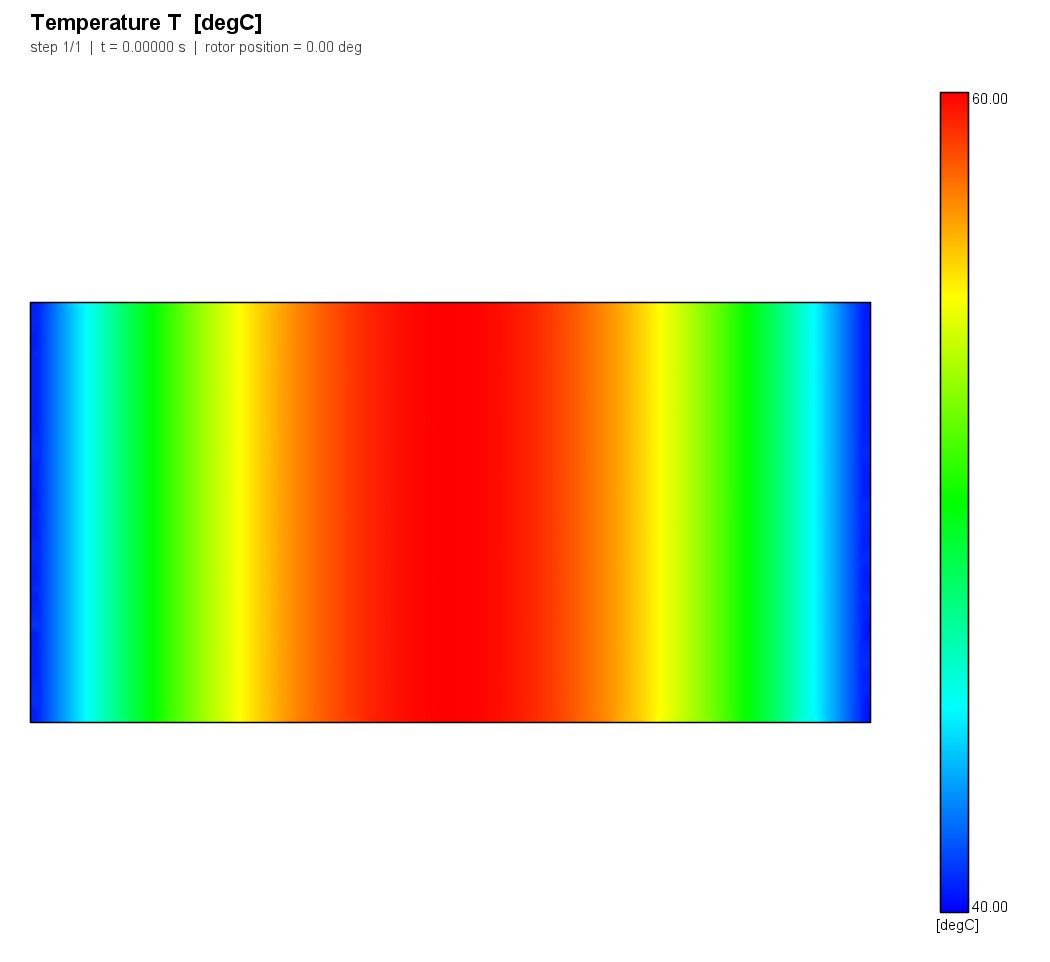
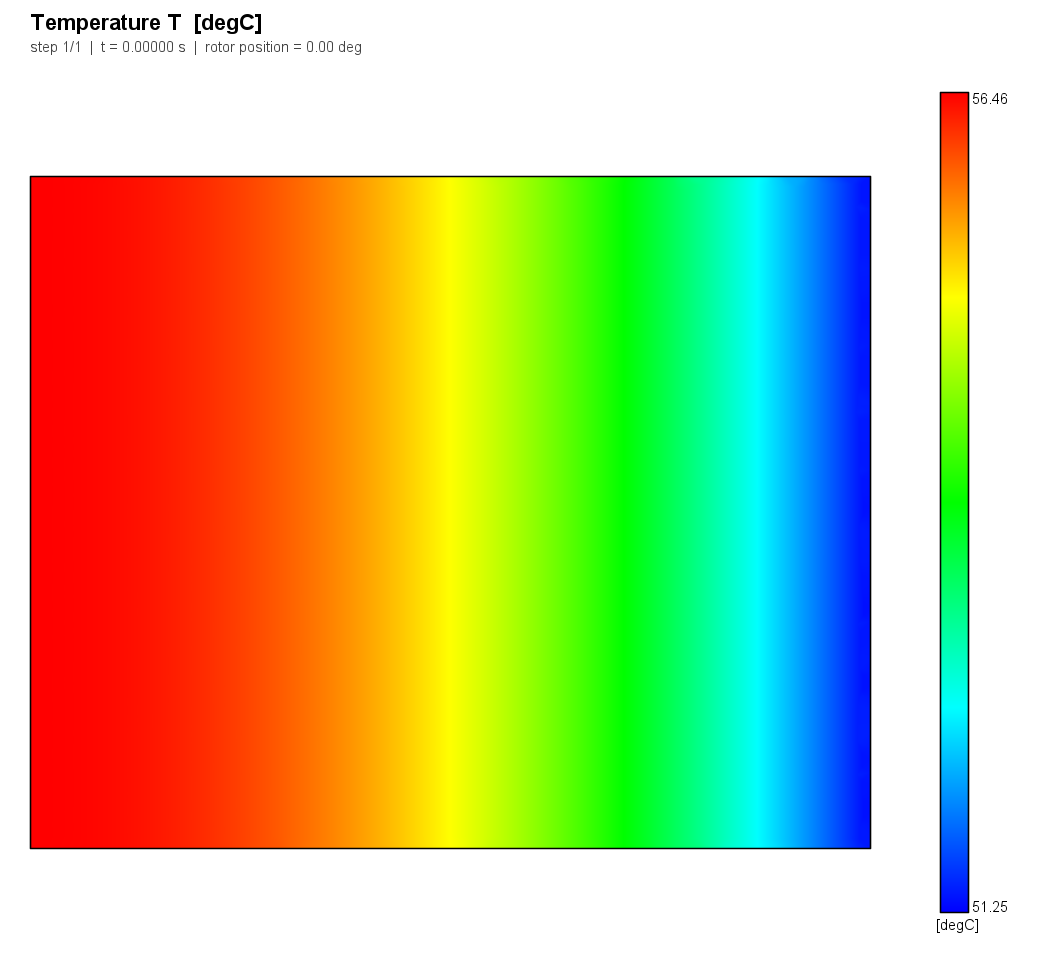
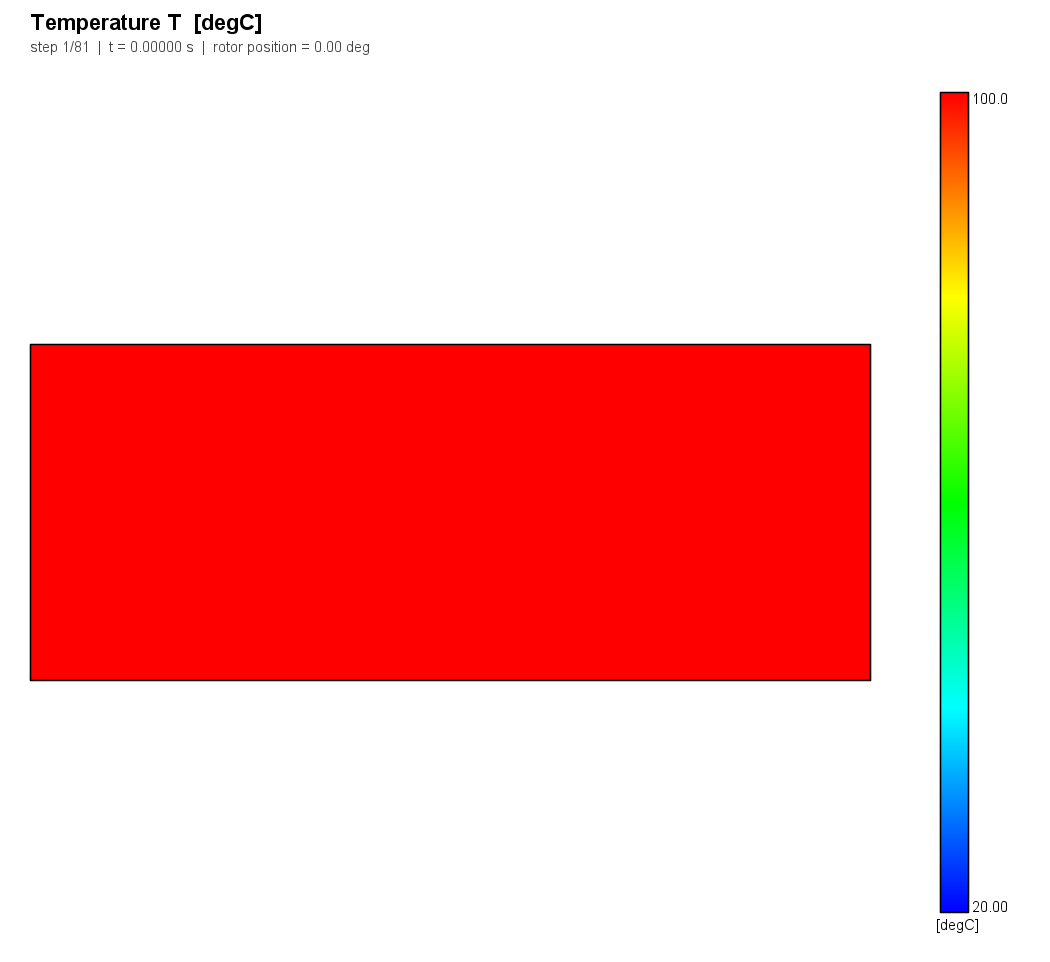
2. Reference
Closed form throughout - Fourier conduction with constant properties, derived
in the case's reference notes and evaluated by harness/analytic.py at run time. A
disagreement between the closed form and the frozen numbers is reported as
DRIFT and fails the case, so the reference cannot move under the chapter.
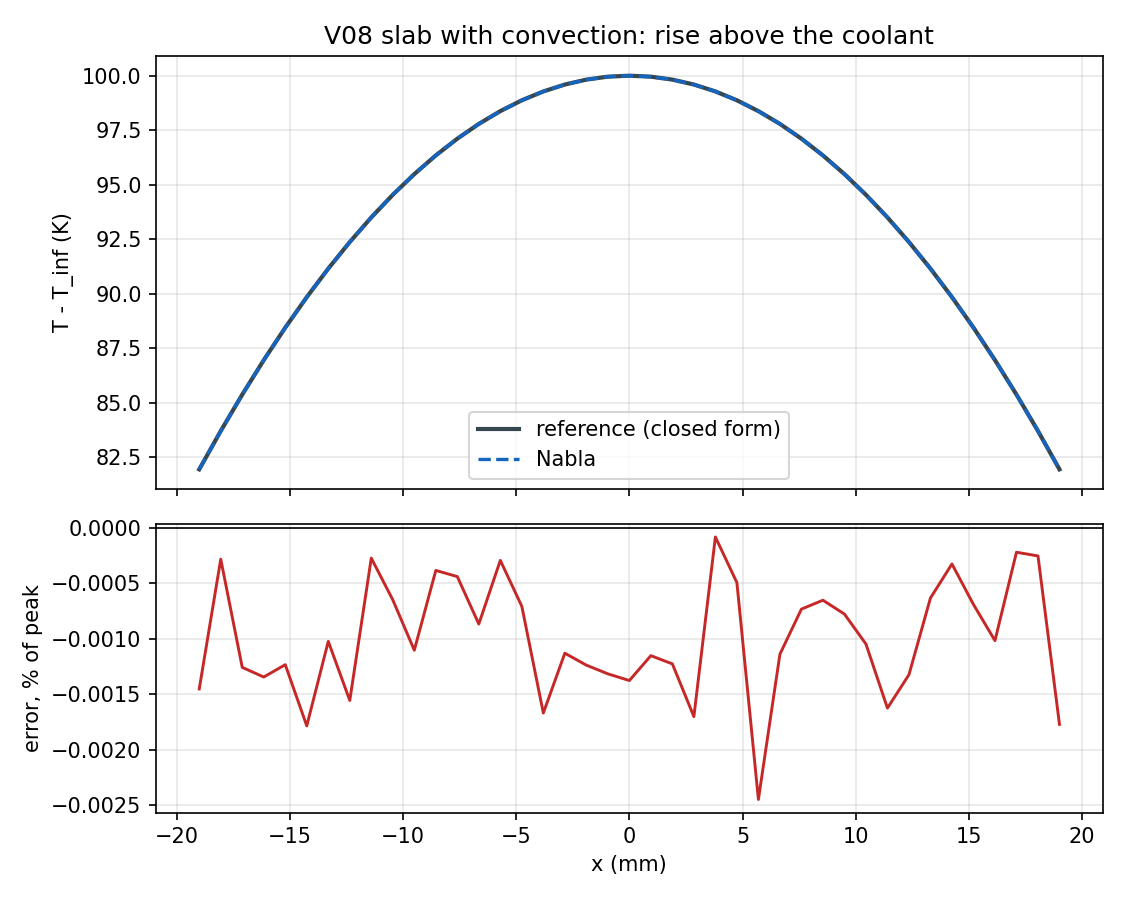
slab      T(x)  = T_s + q (L^2 - x^2)/(2k)            q''(face) = q L
conv      T(x)  = T_inf + q L/h + q (L^2 - x^2)/(2k)
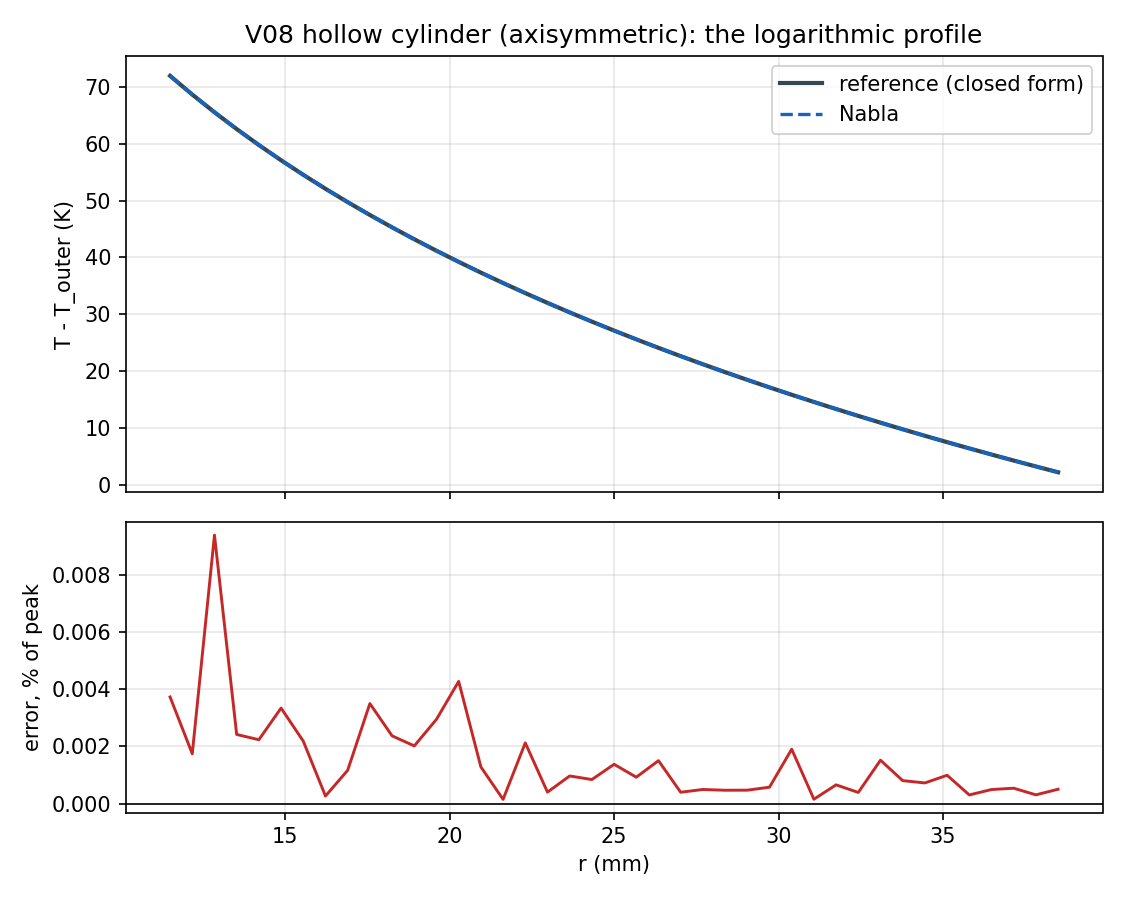
annulus   T(r)  = T1 + (T2 - T1) ln(r/r1)/ln(r2/r1)   Q = 2 pi k H (T1-T2)/ln(r2/r1)
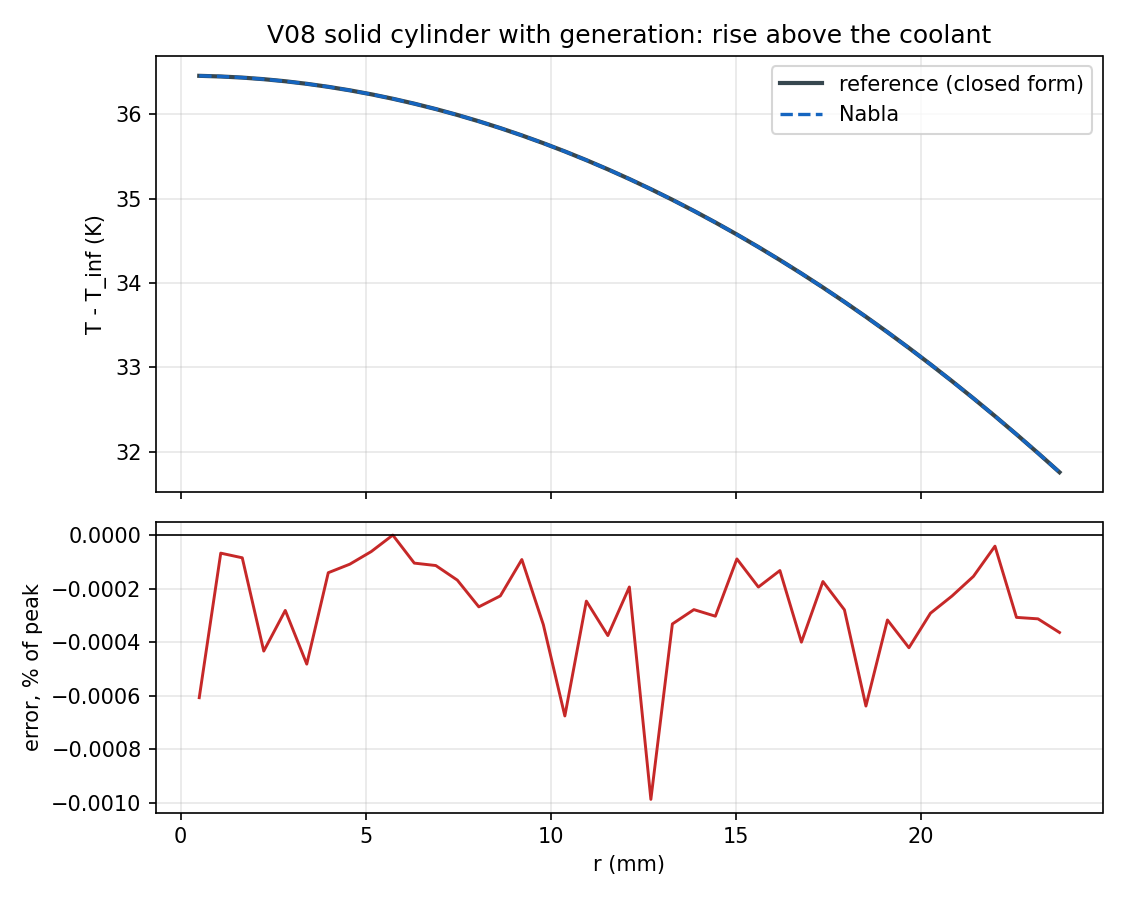
solid     T(r)  = T_inf + q R/(2h) + q (R^2 - r^2)/(4k)
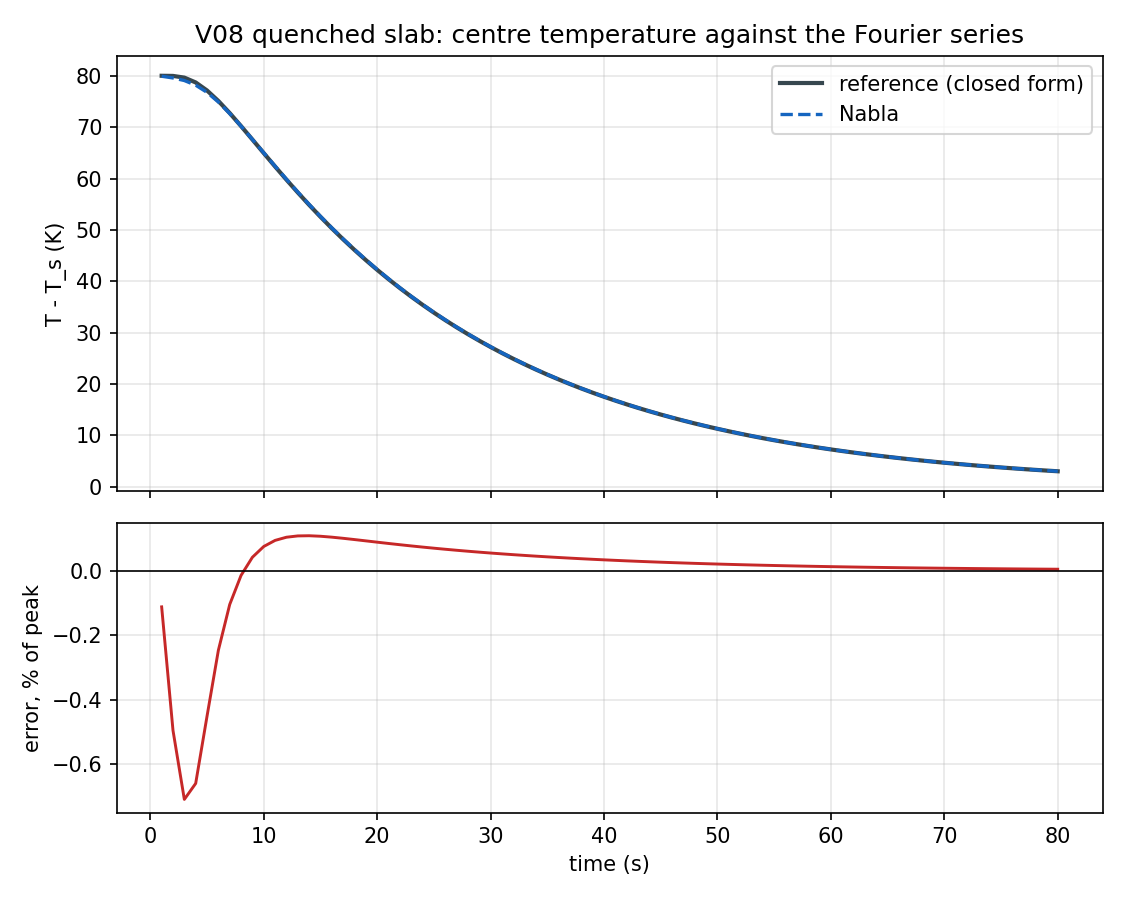
trans     (T - T_s)/(T0 - T_s) = SUM (4/((2n+1)pi)) (-1)^n
                                 cos((2n+1) pi x/2L) exp(-(2n+1)^2 pi^2 Fo/4)
lumped    theta' + theta/tau = q(t)/(rho cp),  tau = rho cp V/(h A)
Sources: Carslaw & Jaeger (2nd ed., ch. 3.3 and ch. 7) for the series and the
cylinder; Incropera & DeWitt (6th ed., ch. 3.5 and ch. 5.1-5.2) for generation
with a convective surface and for the lumped-capacitance criterion. Neither is
needed to check the numbers: every formula above is two lines of algebra and is
written out in harness/analytic.py.
What is judged, and why it is a rise
Every judged profile is a temperature difference from the level the
boundary condition sets - T - T_s, T - T_inf, T - T_outer. 0.5 % of the
60 degC centre reading of the held slab is
mostly 0.5 % of the 40 degC the Dirichlet faces were handed as an input, and
would be met by a solver that got the physics half right. 0.5 % of the 20 K
rise is a real tolerance. The Celsius readings are published as their own
rows - they are simply not where the accuracy claim is made, and the scalar
temperature rows are judged in kelvin against the same fraction of their rise.
The energy balance
Each steady problem also carries a conservation check, and it is read across an
interior surface at 80 % of the way out rather than at the boundary. There
both sides are exactly known - q_x = q x in the slab, q pi r^2 H inside the
rod, 2 pi k H dT/ln(r2/r1) through any cylinder of the annulus - and the
recovered heat flux, which is element-constant before it is nodally averaged, is
not being read one element from a boundary where that averaging is one-sided.
It is the same check as "what leaves equals what was generated", and a harder
one to pass by accident.
3. Nabla model
Built entirely from nabla_api by build.py: geometry as four lines per
rectangle, one region, thermal properties through setThermalRegionProperty,
thermal boundaries through assignBC(20) and assignBC(22), and runThermalSolver() in
place of the harness's default electromagnetic pipeline. The planar models
declare an axial length of 1 m so that every reported watt is a watt per metre;
the axisymmetric ones declare none, because the solver replaces the depth with
2*pi in axisymmetric mode and the model's own z extent is then the height.
| Sub-model | Element order | Nodes | Elements |
|---|---|---|---|
slab_p1 |
P1 | 1555 | 2967 |
slab_p2 |
P2 | 6076 | 2967 |
conv_p1 |
P1 | 1555 | 2967 |
conv_p2 |
P2 | 6076 | 2967 |
annulus_p1 |
P1 | 1770 | 3400 |
annulus_p2 |
P2 | 6939 | 3400 |
solid_p1 |
P1 | 1513 | 2893 |
solid_p2 |
P2 | 5918 | 2893 |
trans_p1 |
P1 | 1235 | 2342 |
trans_p2 |
P2 | 4811 | 2342 |
lumped_p1 |
P1 | 783 | 1461 |
lumped_p2 |
P2 | 3026 | 1461 |
The two orders share a mesh topology - the same element count, the P2 run
carrying the midside nodes - because the only thing changed between them is
polyOrder, and the mesh is regenerated so Triangle is called with -o2.
4. Results
| Quantity | Metric | Nabla | Reference | Error | Tolerance | Verdict |
|---|---|---|---|---|---|---|
slab_rise_profile_p1_K |
profile | min=1.943, max=20, rms=14.8 K | min=1.95, max=20, rms=14.8 K | L2 +0.043 %, max +0.068 % | L2 0.500 %, max 0.750 % | PASS |
slab_centre_p1_degC |
abs | 59.9972 degC | 60 degC | -0.002832 | 0.1 | PASS |
slab_face_flux_p1_W_per_m2 |
rel | 40018.3 W/m^2 | 40000 W/m^2 | +0.046 % | 0.500 % | PASS |
slab_balance_p1_W |
rel | 1280.25 W | 1280 W | +0.020 % | 0.500 % | PASS |
conv_rise_profile_p1_K |
profile | min=81.94, max=100, rms=93.85 K | min=81.95, max=100, rms=93.85 K | L2 +0.007 %, max +0.014 % | L2 0.500 %, max 0.750 % | PASS |
conv_centre_p1_degC |
abs | 124.997 degC | 125 degC | -0.002832 | 0.5 | PASS |
conv_surface_p1_degC |
abs | 105.491 degC | 105.497 degC | -0.006347 | 0.4025 | PASS |
conv_balance_p1_W |
rel | 1280.25 W | 1280 W | +0.020 % | 0.500 % | PASS |
annulus_rise_profile_p1_K |
profile | min=2.207, max=71.95, rms=36.38 K | min=2.206, max=71.93, rms=36.37 K | L2 +0.024 %, max +0.043 % | L2 0.500 %, max 0.750 % | PASS |
annulus_heat_flow_p1_W |
rel | 108.791 W | 108.777 W | +0.013 % | 0.500 % | PASS |
solid_rise_profile_p1_K |
profile | min=31.76, max=36.46, rms=34.87 K | min=31.76, max=36.46, rms=34.87 K | L2 +0.003 %, max +0.010 % | L2 0.500 %, max 0.750 % | PASS |
solid_centre_p1_degC |
abs | 56.4658 degC | 56.4583 degC | 0.007514 | 0.1823 | PASS |
solid_surface_p1_degC |
abs | 51.3533 degC | 51.3536 degC | -0.000327 | 0.1568 | PASS |
solid_balance_p1_W |
rel | 25.1309 W | 25.1327 W | -0.007 % | 0.500 % | PASS |
trans_centre_p1_K |
profile | min=3.012, max=74.89, rms=30.81 K | min=3.012, max=75.09, rms=30.8 K | L2 +0.116 %, max +0.267 % | L2 1.000 %, max 1.500 % | PASS |
trans_half_p1_K |
profile | min=2.13, max=57.81, rms=22.24 K | min=2.13, max=57.52, rms=22.2 K | L2 +0.233 %, max +0.505 % | L2 1.000 %, max 1.500 % | PASS |
trans_startup_p1_K |
report | [79.91124252435219, 79.57696223261244, 79.07817649161628, 78.17774796292977, 76.77731711153336] K | - K | - | - | REPORT |
lumped_centre_p1_K |
profile | min=1.556, max=75.82, rms=40.09 K | min=1.367, max=75.51, rms=39.81 K | L2 +0.861 %, max +0.509 % | L2 1.000 %, max 1.500 % | PASS |
lumped_startup_p1_K |
report | [0.07911904817776971, 0.23423331699050465, 0.4623414543636635, 0.7605606326405798, 1.1261218787358622] K | - K | - | - | REPORT |
lumped_final_p1_K |
rel | 75.8209 K | 75.5144 K | +0.406 % | 1.000 % | PASS |
slab_balance_signed_p1_W |
report | [-639.9625037361353, 640.2921506019713] W | - W | - | - | REPORT |
conv_balance_signed_p1_W |
report | [-639.9620790993392, 640.2919500944433] W | - W | - | - | REPORT |
annulus_heat_flow_signed_p1_W |
report | 108.791 W | - W | - | - | REPORT |
solid_balance_signed_p1_W |
report | 25.1309 W | - W | - | - | REPORT |
slab_rise_profile_p2_K |
profile | min=1.948, max=20, rms=14.8 K | min=1.95, max=20, rms=14.8 K | L2 +0.008 %, max +0.012 % | L2 0.100 %, max 0.200 % | PASS |
slab_centre_p2_degC |
abs | 59.9986 degC | 60 degC | -0.001376 | 0.02 | PASS |
slab_face_flux_p2_W_per_m2 |
rel | 40000 W/m^2 | 40000 W/m^2 | +0.000 % | 0.500 % | PASS |
slab_balance_p2_W |
rel | 1280 W | 1280 W | +0.000 % | 0.500 % | PASS |
conv_rise_profile_p2_K |
profile | min=81.95, max=100, rms=93.85 K | min=81.95, max=100, rms=93.85 K | L2 +0.001 %, max +0.002 % | L2 0.100 %, max 0.200 % | PASS |
conv_centre_p2_degC |
abs | 124.999 degC | 125 degC | -0.001376 | 0.1 | PASS |
conv_surface_p2_degC |
abs | 105.495 degC | 105.497 degC | -0.002009 | 0.0805 | PASS |
conv_balance_p2_W |
rel | 1280 W | 1280 W | +0.000 % | 0.500 % | PASS |
annulus_rise_profile_p2_K |
profile | min=2.206, max=71.94, rms=36.37 K | min=2.206, max=71.93, rms=36.37 K | L2 +0.004 %, max +0.009 % | L2 0.100 %, max 0.200 % | PASS |
annulus_heat_flow_p2_W |
rel | 108.778 W | 108.777 W | +0.001 % | 0.500 % | PASS |
solid_rise_profile_p2_K |
profile | min=31.76, max=36.46, rms=34.87 K | min=31.76, max=36.46, rms=34.87 K | L2 +0.000 %, max +0.001 % | L2 0.100 %, max 0.200 % | PASS |
solid_centre_p2_degC |
abs | 56.4583 degC | 56.4583 degC | -6.889e-05 | 0.03646 | PASS |
solid_surface_p2_degC |
abs | 51.3536 degC | 51.3536 degC | -6.026e-05 | 0.03135 | PASS |
solid_balance_p2_W |
rel | 25.1327 W | 25.1327 W | -0.000 % | 0.500 % | PASS |
trans_centre_p2_K |
profile | min=3.016, max=74.9, rms=30.83 K | min=3.012, max=75.09, rms=30.8 K | L2 +0.153 %, max +0.263 % | L2 1.000 %, max 1.500 % | PASS |
trans_half_p2_K |
profile | min=2.133, max=57.86, rms=22.26 K | min=2.13, max=57.52, rms=22.2 K | L2 +0.301 %, max +0.593 % | L2 1.000 %, max 1.500 % | PASS |
trans_startup_p2_K |
report | [79.91025509892577, 79.57441363989808, 79.07413303924466, 78.17331729319503, 76.77529168231351] K | - K | - | - | REPORT |
lumped_centre_p2_K |
profile | min=1.556, max=75.82, rms=40.09 K | min=1.367, max=75.51, rms=39.81 K | L2 +0.861 %, max +0.509 % | L2 1.000 %, max 1.500 % | PASS |
lumped_startup_p2_K |
report | [0.07911886125125989, 0.23423276618251876, 0.4623403722958699, 0.7605588609824423, 1.1261192677498144] K | - K | - | - | REPORT |
lumped_final_p2_K |
rel | 75.8207 K | 75.5144 K | +0.406 % | 1.000 % | PASS |
slab_balance_signed_p2_W |
report | [-640.0000000000131, 640.0000000000549] W | - W | - | - | REPORT |
conv_balance_signed_p2_W |
report | [-640.0000000001744, 640.0000000002199] W | - W | - | - | REPORT |
annulus_heat_flow_signed_p2_W |
report | 108.778 W | - W | - | - | REPORT |
solid_balance_signed_p2_W |
report | 25.1327 W | - W | - | - | REPORT |
transient_alpha_m2_per_s |
report | 1.11483e-05 m^2/s | - m^2/s | - | - | REPORT |
lumped_tau_s |
report | 243 s | - s | - | - | REPORT |
lumped_biot |
report | 0.00125 - | - - | - | - | REPORT |
trans_startup_p1_K: published without a verdict, by declarationlumped_startup_p1_K: published without a verdict, by declarationslab_balance_signed_p1_W: published without a verdict, by declarationconv_balance_signed_p1_W: published without a verdict, by declarationannulus_heat_flow_signed_p1_W: published without a verdict, by declarationsolid_balance_signed_p1_W: published without a verdict, by declarationtrans_startup_p2_K: published without a verdict, by declarationlumped_startup_p2_K: published without a verdict, by declarationslab_balance_signed_p2_W: published without a verdict, by declarationconv_balance_signed_p2_W: published without a verdict, by declarationannulus_heat_flow_signed_p2_W: published without a verdict, by declarationsolid_balance_signed_p2_W: published without a verdict, by declarationtransient_alpha_m2_per_s: published without a verdict, by declarationlumped_tau_s: published without a verdict, by declarationlumped_biot: published without a verdict, by declaration
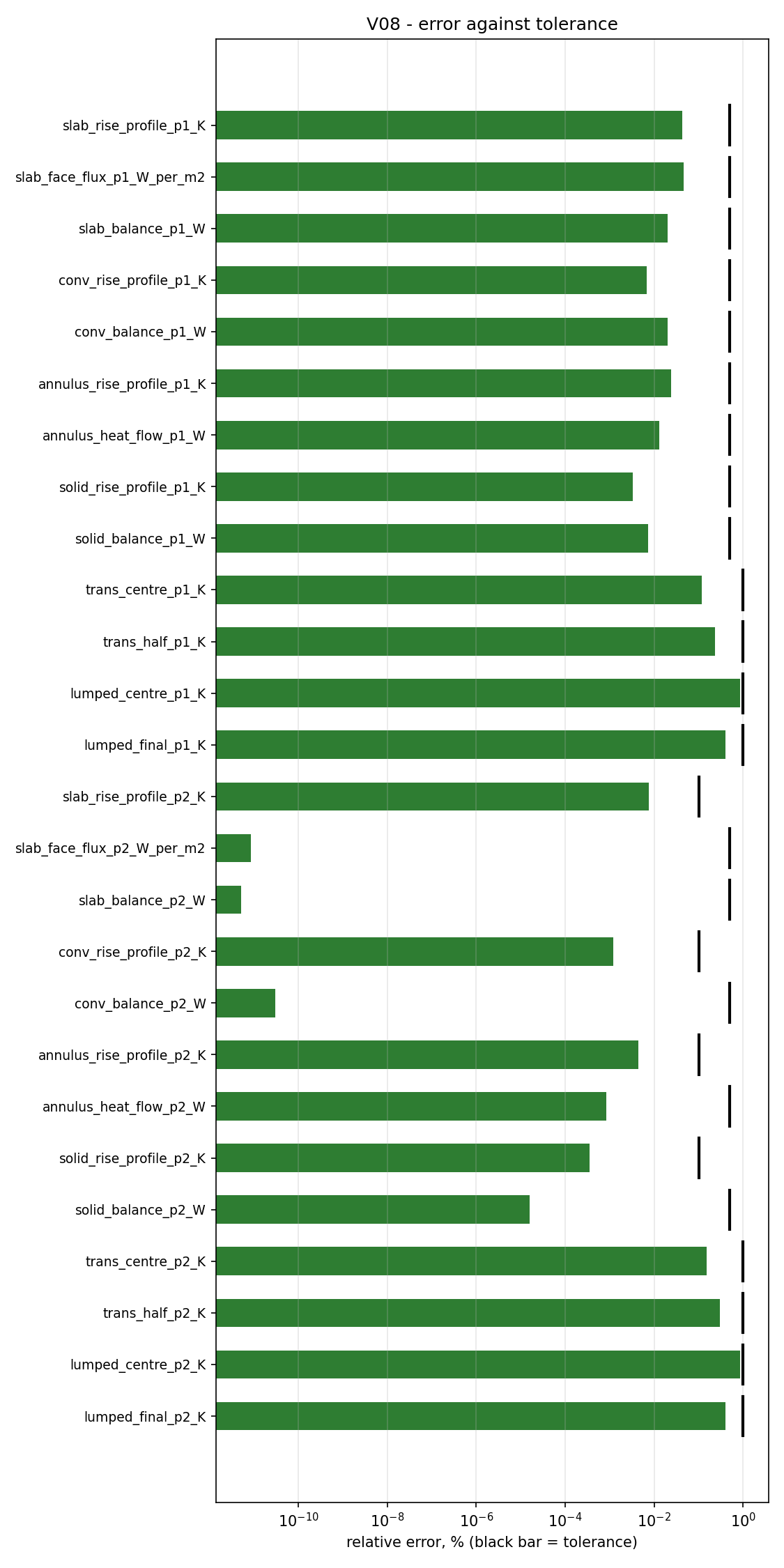
Three things in that table are worth reading twice.
P2 is not "more accurate" here; on three of the four steady problems it is
exact. The slab and the cooled slab have parabolic solutions and the solid
cylinder's is a parabola in r; a quadratic element reproduces them to the
linear solver's tolerance and nothing else. The energy balance says it plainly:
1280 W against a generated 1280 W,
an error of +0.000 %. That is not a tolerance being met,
it is the discretization error being zero. The annulus, whose solution is
logarithmic and therefore not in the P2 space, is the one that still shows a
finite error - +0.004 % L2 against
+0.024 % at P1.
The axisymmetric heat flow is the load-bearing row. A profile can be right
while the r weight in the kernel and the 2*pi depth override are both wrong -
they do not appear in the temperature at all. Only an integrated power sees
them, and annulus_heat_flow is that number: 108.778 W
against the closed form's 108.777 W
(+0.001 %).
The transient is held to a tolerance the scheme can meet, and says so. See the discussion below.
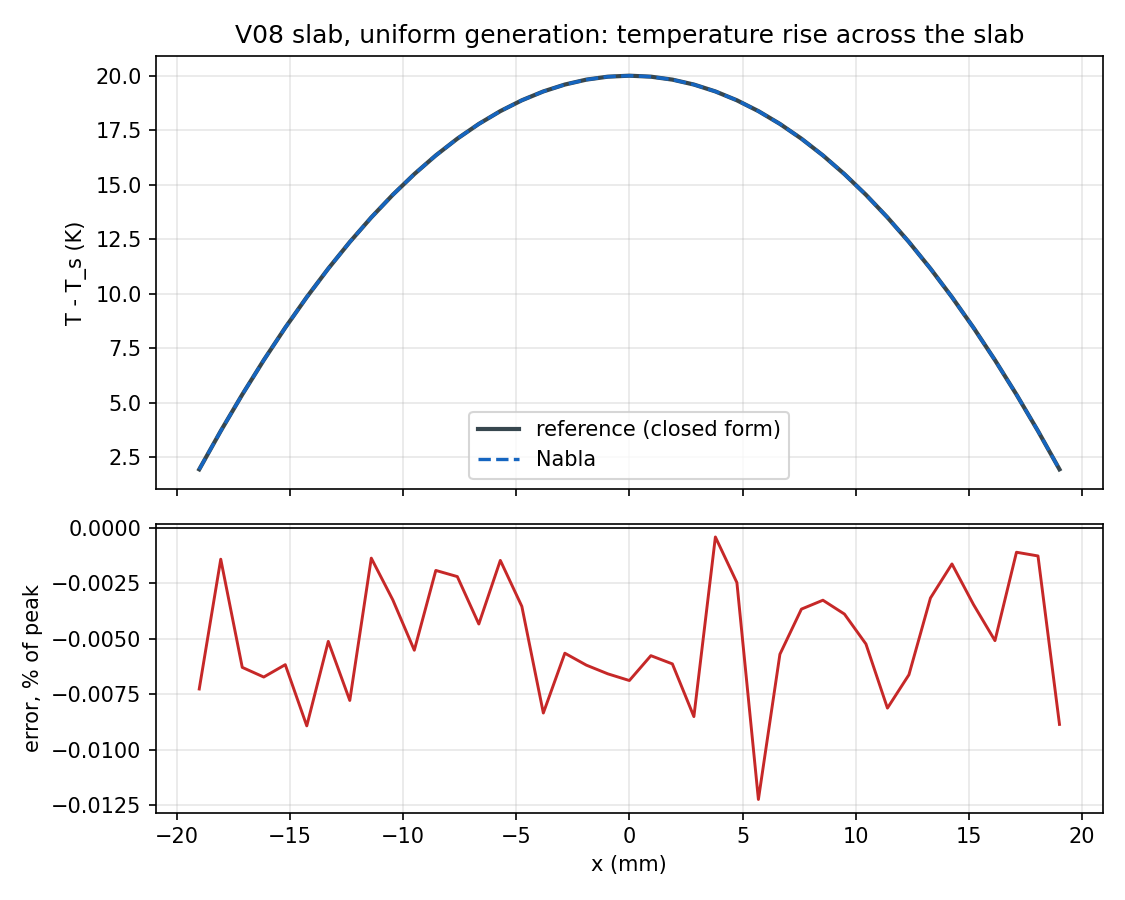
5. Discussion
The transient is run with Crank-Nicolson, and that is a statement about Backward Euler
The validation plan V08 asks for 1 % after the first five steps. The slowest
mode of the quenched slab has lambda_1 = alpha (pi/2L)^2 = 0.044 1/s, and a
first-order scheme accumulates roughly lambda^2 dt t/2 on it - about 16 %
by t = 80 s at dt = 2 s. That is Backward Euler being first order, not
Nabla being wrong, and holding the code to 1 % under it would have meant either
620 time steps or a tolerance chosen to be met rather than to mean something.
So the quenched slab runs Crank-Nicolson with a two-step Rannacher startup, and lands at +0.153 % L2 (P2) / +0.116 % (P1) over records 6 to 80. Backward Euler is still exercised - by the lumped sub-model, where it happens to be exact (below). The order study itself is V19's subject, and this case's numbers are one of its inputs rather than a substitute for it.
The first five records are published without a verdict, on purpose. The initial
condition is discontinuous - the interior at 100 degC, the faces at 20 degC from
t = 0+ - so every mode the mesh can carry is excited at once, the first two
steps are Backward Euler by design to damp them, and this is where a
time-integration bug would show. Showing it is more useful than judging it
against a series that is itself slowest to converge exactly there.
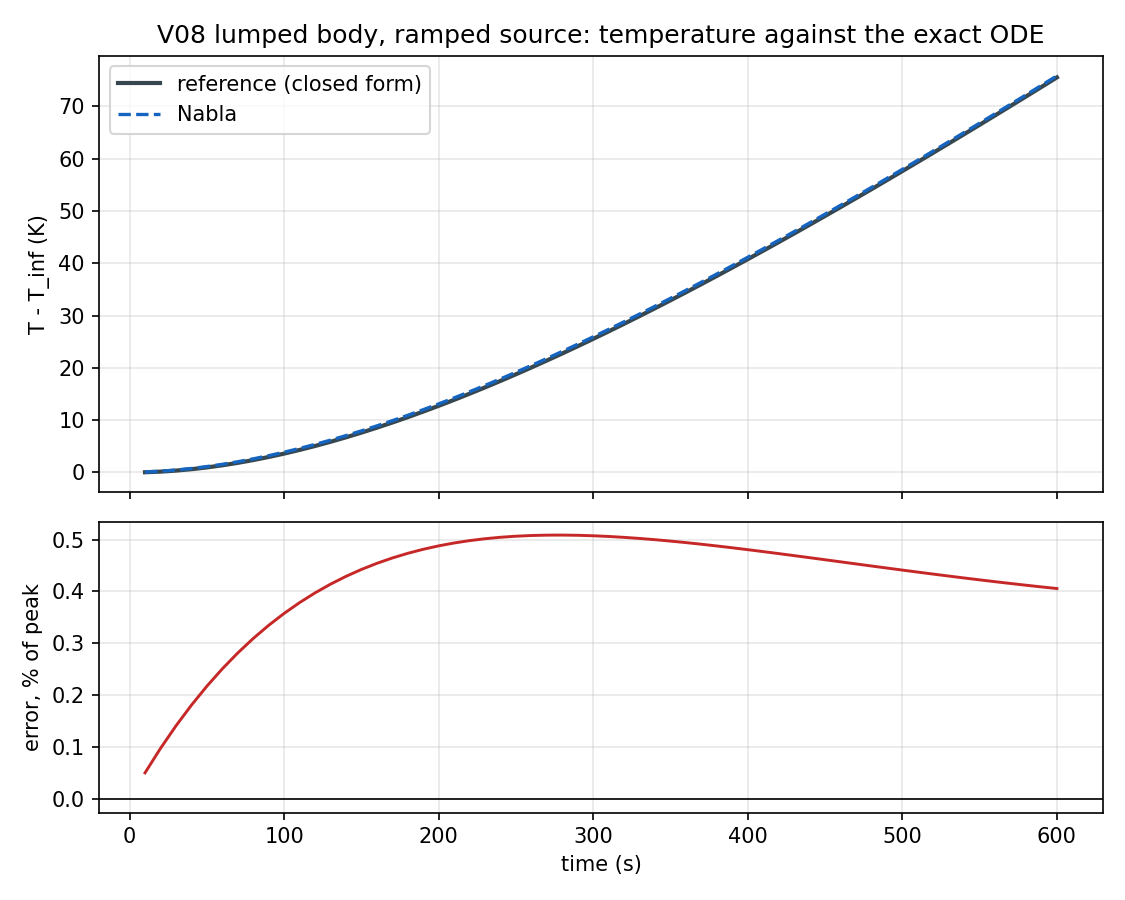
Backward Euler is exact on the lumped ramp, which is why the ramp was chosen
The lumped body is driven by a two-point heat-source table, q(t) = 2000 t.
Two things follow. The solver interpolates the table linearly in time, so a
ramp is represented exactly and the reference stays a closed form rather
than becoming a quadrature. And Backward Euler applied to
theta' + theta/tau = a t reproduces the continuous particular solution
theta_p = a tau (t - tau) term for term - substitute theta^n = A t_n + B and
the discrete equations give A = a tau, B = -a tau^2, the same coefficients.
The scheme's whole error therefore sits in the decaying homogeneous part, whose
amplitude is 48.6 K at t = 0 and 4.1 K at the end.
What is left over is the reference's error, not the solver's. The measured
final rise is 75.8209 K against the lumped ODE's
75.5144 K, +0.406 % high - and
it should be high, because the probe is at the centre of a body that is not
actually isothermal. With Bi = 0.00125 the centre sits a few
tenths of a kelvin above the lumped mean, which is what the +0.3 K is. That is
why lumped_biot is published as a row of its own: a document that quotes a
lumped answer without quoting its Biot number is quoting an unbounded error.
P1 and P2 agree to the last digit here, which is the other half of the same
statement - the residual is not discretization.
One harness trap, recorded because it cost a run
The energy balance is integrated as mean(q_n) * length, not with a trapezoid
over the arclengths the contour probe returns. The probe subdivides a path into
nSamples - 1 segments and returns one value per segment tagged with that
segment's starting arclength, so the reported abscissae stop one segment
short of the end. A trapezoid over them integrates over 1 - 1/(n-1) of the
contour: a clean -0.5 % at 200 segments, which is exactly the tolerance
this case's conservation check is held to. On the first run all four balance
rows came in at -0.48 to -0.51 % and one of them failed - for a reason with
nothing to do with the solver. The segment mean times the geometric length is
the Riemann sum those samples actually are, and after the fix the P2 balances
are exact to thirteen digits.
6. Limitations
What this case does not prove:
- Nothing is coupled. The thermal module is uncoupled from the electromagnetic solver: no loss field is passed to it here, no temperature is fed back to a material. The loss-to-thermal handoff is V23's subject.
- Every material is linear and constant. No temperature-dependent
k, no contact resistance, no radiation (BC type 23 is reserved and unimplemented). - No convection is modelled, only its boundary condition.
his an input; nothing here validates a heat-transfer correlation. - The geometries are 1-D solutions on 2-D meshes - straight or circular boundaries, smooth solutions, no re-entrant corner. That is deliberate (it is what makes exactness the expected answer, and P2's exactness meaningful), and it means this case says nothing about a singular corner.
- The transient tolerance is a statement about a scheme at a step size, not a general accuracy claim. Read it with the discussion above and with V19.
- BC type 21 (imposed heat flux) is not exercised here. Types 20 and 22 are. A flux boundary appears in the thermal solver specification's own V3 check; adding it to this register is open work.
- Periodic thermal boundaries (types 3 and 7) are not exercised.
7. Reproduce
cd validation
python -m harness.run_case V08
Needs a built solver (make solver), triangle.exe (make triangle; 32-bit
on Windows), and a licence carrying the Thermal feature - the thermal
module and P2 elements are both gated, and without them the case cannot run at
all rather than running degraded. The twelve models are written under
artifacts/models/ and can be opened in the GUI.
To regenerate the frozen expectations from the closed forms alone:
python cases/V08_heat_conduction/reference/freeze_expected.py
Frozen-reference changelog
| Date | Change | Reason |
|---|---|---|
| 2026-08-13 | frozen at case creation | Every reference value is a closed form evaluated from the parameters in build.py, and every tolerance is transcribed from the validation plan V08. No number here was read off a Nabla run; reference/freeze_expected.py regenerates the file from the same two sources. |